Featured

Creative Autobiography

Semester B – Third Year – Alternative Education

Reflection Week 1:

Today was my first session back at University following the Christmas break. We have now officially finished Semester A and have moved onto Semester B, which means we are now being introduced to the final modules of the Education Studies course. One of these modules is ‘Alternative Education’, which I have been looking forward to starting, even more so since I began working within alternative education facilities as a teaching assistant. One of the tasks we have been given during this first session is to create a journal where we, as students will reflect on the sessions of this specific module each week. Which bring me here, my reflection of the first session:

Upon the session beginning, we were shown a video extract from the Truman Show, which can be seen below.

After watching this short clip, we were asked to think about a example from our own experiences of a moment your own (metaphorical) yacht hit the wall. I found this task quite emotional as it made me realise how far I have come, both academically and professionally, since a time in my life which I found extremely difficult. Although I didn’t feel the need to share my ‘hit the wall’ moment with the rest of the group, I feel as thought this task was extremely thought provoking and made me reflect and realise that sometimes when you feel as though everyone is against you and your life has come to a strict hault, if you are passionate enough to make things happen, you can make it happen. And even if the changes take a lot of time and effort, it will be worth it when you take time to sit and look back.

“Learn to trust your own feelings and encourage activities…that allow personal insights to be respected in your class.

Greta Nagel (The Tao of Teaching, 1994)

Reflection Week 2: “This Session Has No Teacher”

Prior to this session today, we were advised to go away and read some papers from different thinkers surrounding education. On arrival of todays session, there was a notice on the board which stated “this session has no teacher”. My initial thoughts were that we wouldn’t get much out of todays lesson however, this opinion soon changed when the discussion started within the classroom. While I had read John Taylor Gatto -‘Dumbing us Down’ (2005) and the chapter ‘The Seven Lesson School Teacher’ prior to the session today, other members of the group had read differing papers. This worked well as when I discussed ideas which I has gained from one specific paper, other members of the group were then able to elaborate, agree or even disagree with things that were being said. I find this way of learning extremely beneficial as it opens your mind to views and opinions which you may never have considered. Our job roles outside of university also played a part within this session and the experiences which we have had. I personally work within a pupil referral unit in secondary education, whereby one of my peers works in a mainstream primary education facility. Listening to the differing views and the organisational logistics of her workplace as opposed to mine was both eye-opening and thought provoking.

However, while I feel as though there are many benefits to sessions such as this one where there was no obvious teacher/facilitator, there were also some very obvious negatives. The main thing which stood out to me today was that it seemed to be the same people who contributed to the session, speaking out-loud and portraying their opinions to the rest of the group. In-fact, more than 75% of the group did not contribute in anyway to the session. While I completely understand some of my peers may not have felt comfortable in doing so, I cant help but feel that if everyone shared their experiences, views and opinions, the learning for each of us would have much more rich as we would have numerous other criticisms, ideas and experiences to discuss, enabling the group to develop their knowledge even further. This suggests then that while some students may find this approach to education beneficial, other students may require more structure to the sessions with specific objectives and a facilitator to support the session to move forward.

Reflection Week 3: Class and the Impact On Education.

Initially, I really struggled with this session as I, personally don’t have any relatable experience surrounding the impact of class. However, looking back now after the session, it could be said that this was me being completely ignorant to it and making up other excuses for the different ways people of different classes/social backgrounds are being treated.

One thing that really stuck out to me during this session was the idea of class not being a protected characteristic. Therefore, if someone made de-moralising comments or treating people differently due to their race, religion, gender or disability, it would be classed as wrong. However, within society, there are no policies or legislation which state that it is wrong to treat someone differently because of their social class whether it be refusing them a place at a specific educational facility, or offering someone from a higher class background the job opposed to the working class applicant.

During this session, there were numerous books on the desks when I walked into the room. Because this was unusual, I had a look and was interested in one of the books ‘Chavs – The Demonization of the Working Class’ by Owen Jones (2011) and took it back to my seat.

When some of the pupils and tutor were in discussion I had a flick through the book and found a chapter which I was able to relate to as it is something I have grown up with all over the news. The disappearances of both Shannon Matthews and Madeline McCann. While the differences of the investigations, the media coverage and even the reward money never struck me as being due to class differences of the families, this book explained how it linked so well. I feel as though this was a lightbulb moment for me and made me realise that the impact of social class is extremely powerful and un-fair.

I feel as though having books within the classroom is an extremely clever way to support the education of students, especially those in higher education – however this could work for all education facilities. Throughout the start of the lesson I struggled to relate anything to the differentiation of social class and therefore, found it difficult to engage fully. However, being able to take some time to read this book on my own and find something which made it easy to understand and relate to the differences of social class really supported me. I have now brought this book home and continued to read this chapter as I found it extremely interesting and feel as though it will support my learning further when relating social class to education.


Learning Outcome 4 Reflection.

This week our task was to produce a set of rules/guidelines for an online group. These rules/guidelines would need to ensure that the group runs as smoothly as possible. We were instructed to use ‘Prezi’, an online presenting tool which I have personally never used before. We were able to get ourselves into groups and therefore, myself, Lauren and Abigail chose to work together as we feel we have the same worth ethic.

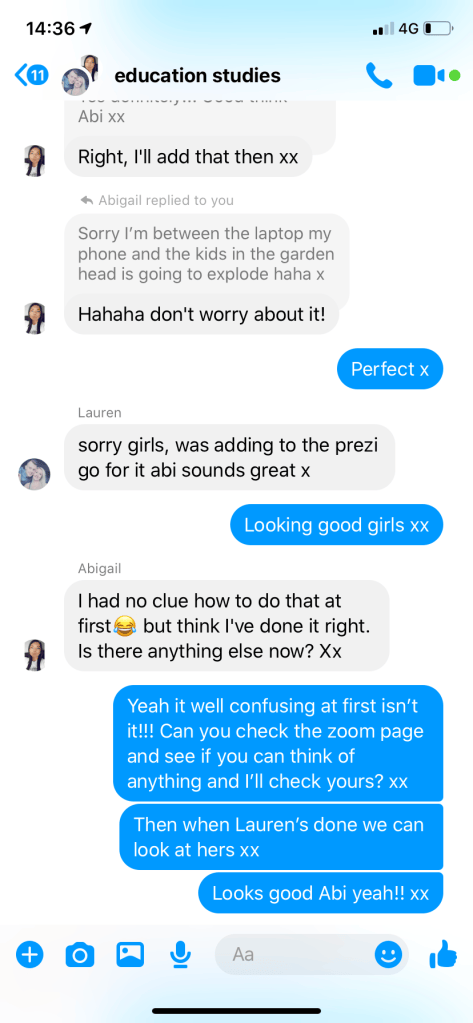
Following the class meeting on Zoom, we decided to get on with the task straight away. First, we discussed how we would communicate most effectively through the development of the Prezi. It was decided by all three of us that Facebook Messenger would work well for us all and would also enable us to screenshot our messages to support the reflection task.

Lauren came up with the idea of creating guidelines surrounding a mother and baby group, both myself and Abi agreed this was a brilliant idea and communicated this support to Lauren to ensure she felt confident with her decision. I then put my idea across surrounding the name for the group ‘Lancashire Mother and Baby Group’ which both Lauren and Abi agreed with.

I made a start with the development of the Prezi as I had already made an account previous to the session. I thought it would be beneficial to send a photo to the group which allowed them to see what I had done so far.

This is the homepage which I managed to create which I sent to the rest of the group for consultation.

While the group members expressed how pleased they were with what I had done, I was finding it really difficult to use the Prezi software, mostly due to navigation issues with it being the first time I had used it.

I mentioned my concerns to the group, and they agreed to help me try and figure this out. We shared the log in details with each other and then started to work on it together. I focused on the homepage and the rules and guidelines for Zoom calls while Lauren focused on the rules and guidelines for the Facebook group. Abigail started to create an ‘About Us’ page. I fell tlike this worked really well as we all had a specific job role.

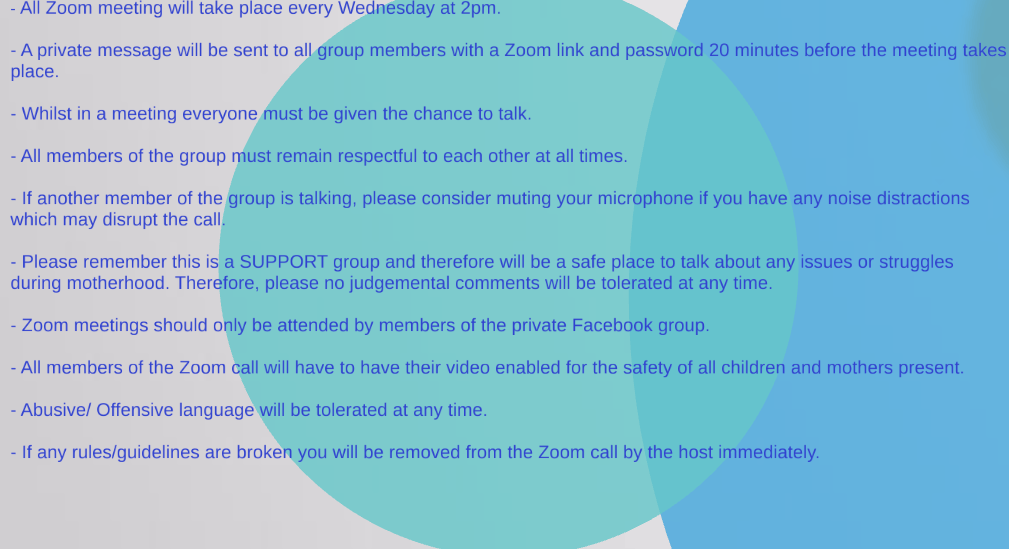
I worked on developing the pages which explained the rules and guidelines for the Zoom meetings.
This is the page where the rules and guidelines were listed on the Prezi presentation.

While we were working, we all found that it was getting easier and easier to navigate and also that it is a suitable presentation design idea which would work extremely well in education. I decided it would be a good idea to check each other’s pages of the Prezi to see if there was anything we could add.

I asked the group if they would find it beneficial if I checked their finished pages, and they could check mine to ensure everybody was happy with the whole presentation.

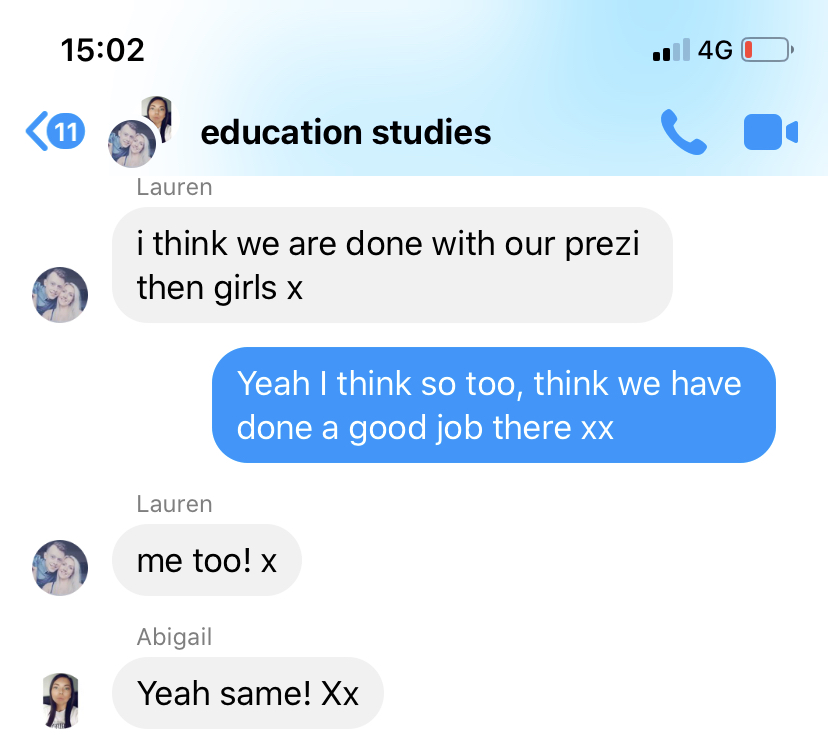
Upon completion, I ensured I communicated how well I thought we had worked together as a group as I feel this is important to share. I really enjoyed making this presentation with the group and I believe we made really good progress and worked really well together as a supportive team.

To view our Prezi surrounding the rules and guidelines for a mother and baby group, please follow this URL: https://prezi.com/view/23mlXZWYHZR5vSsqYweF/

Creation of a Board Game Using Technology.

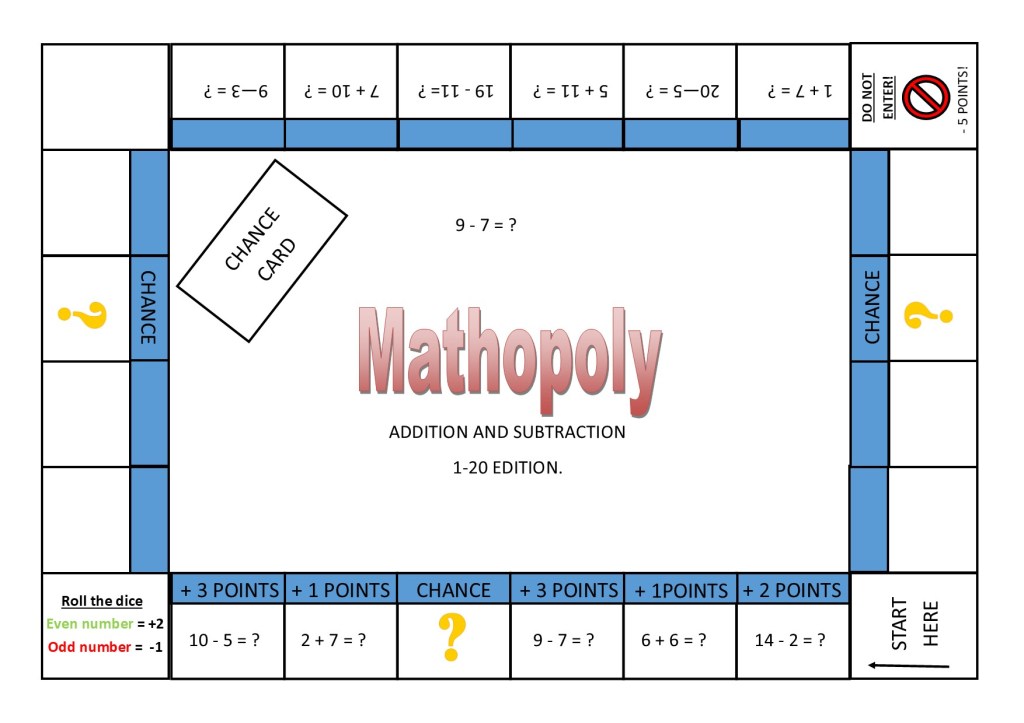
Our task for today was to create a board game for primary school aged children. This creation needed to be done through the use of technology and software of our choice. I decided to use Publisher as I am confident with using this design software and know how to use the basic tools for creating a simple design. ‘Mathopoly’ is the name of my board game, with the age range being children ages 5-8. It has been made to support the mathematics learning for up to four children at a time focusing on addition and subtraction of numbers 0-20.

The layout of the board game is inspired by the mortgage trading game ‘Monopoly’ and I feel it works well as it is an easy board for young children to find their way around. When a child lands on a square, they would need to answer the maths question correctly. If this is done so, they will recieve the amount of points which is stated on that same square.

In order to win this game, you need to recieve 20 points before the other players. A teacher/parent or carer would need to be present in order to support the players with their point counting, however I have ensured that throughout the game and even considering the points system, that there will be no numbers above that of 20 to keep in line with the National Curriculum for a five year old child.

I have really enjoyed creating this game board and also taking into consideration the age of the children at all times. Publisher is a suitable design software in order to create a boardgame like this and I have not found any faults while doing so.

Rebecca

28.04.2020 – Gamification Poster.

Due to the United Kingdom still in a state of ‘Lockdown’ due to the coronavirus, this session was again started via Moodle. I said ‘Hello’ and waited for further instruction regarding the session while Mark replied and welcomed everybody individually.

While we waited for the instruction from Mark, I set aside some time to reflect upon my personal experience with virtual learning so far:

I have been really struggling with the virtual teaching. My husband has a job which required him to work and therefore I am at home with my three children. While they would usually be in childcare while I attend university, all of their childcare provisions have closed. I am struggling with balancing my home-life, parenting, home schooling and managing my time effectively to complete my own assessments in readiness to finish year one. All of my university sessions are now being run through ‘Zoom’ the online video conference system. While this system is extremely practical for some users, I have been finding it extremely stressful. I have been finding it hard to engage within the sessions as my microphone needs to be turned off due to my children attempting their classwork or playing in the background and I have also found that sitting at the laptop for long periods of time while also caring for my children has not been working well for me and I have left numerous sessions feeling extremely upset, deflated and worried. While I understand that some of the information is uploaded onto Moodle for us, I find that without being able to engage within the session properly is having a negative effect on my learning. I have found that I am struggling more with understanding the work which is also effecting my ability to complete assignments.

Research team task and poster

Todays session is based on technology and how it is being used within the classroom. We were each given a number between 1 & 4 which represented a subject which we would need to research in small groups before promoting through the individual development of an A3 poster. The subjects were as follows:

1. Virtual reality and immersive learning

2. Adaptive learning software

3. Gamification

4. Artificial Intelligence

I was given the number 3 which meant that I had to research Gamification.

I believe that giving random numbers effected my work as some members of the group are extremely shy and are unwilling to participate within the group. We also had issues with one member of the group who’s microphone and camera doesn’t work and so she couldn’t participate fully either. During group work I find that I am usually extremely vocal, however, due to having my children at home and therefore could not have my microphone on at all times I decided to put the idea forward to use a chat type platform such as google hangout or WhatsApp. This would allow all members of the group to participate well together.

We decided to use WhatsApp as we agreed as a group that this would work best for each of us. Once that chat had been set up, we split the subject of gameification into three. What is it in general, how it can be used in education and what we think it will help with in the future.

I decided to look further into how it can be used within education. Once we had researched these ideas further, we then met back on Zoom to discuss how to use the software ‘In Design’. Due to the current situation, Mark could only give us a very limited demonstration through the Zoom share screen facility. I made notes throughout in order to help when I had installed the software.

Unfortunately, on installing the software I met with numerous problems due to my student log in which resulted in my having to use Microsoft Publisher to create my poster. While I was frustrated because I did want to try and attempt to use a new software, I found the use of publisher extremely simple due to using it numerous times as part of a previous job role.

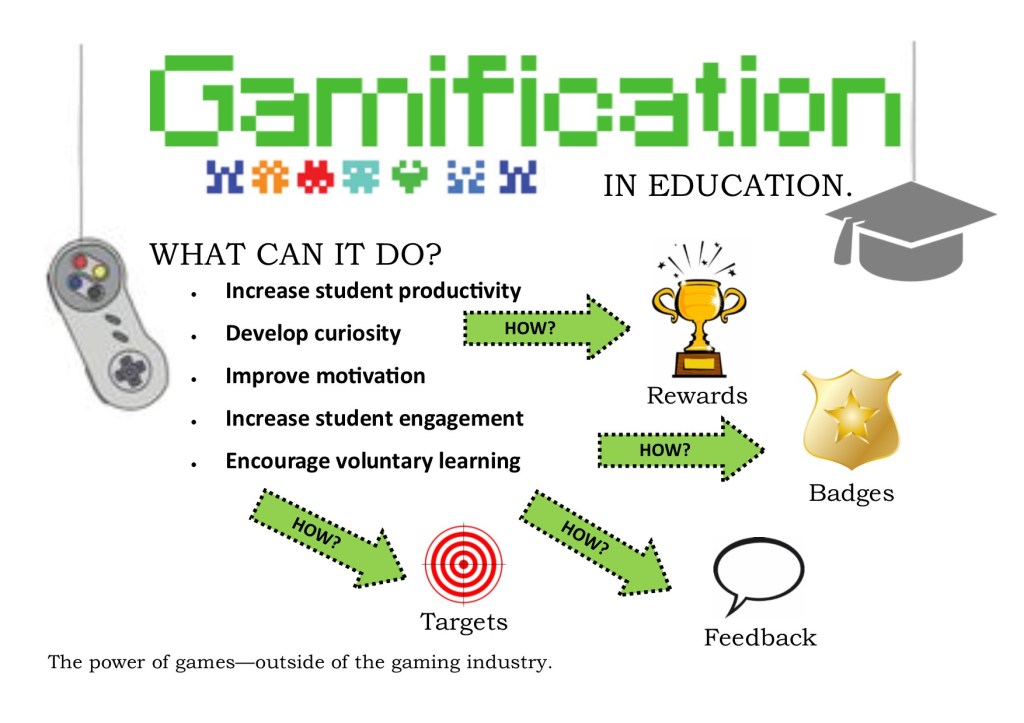
I am really pleased with the ‘Gamification’ poster which I was able to create using Publisher. I found it really easy to add images, text and also move these around to where I wanted them to be. I believe that I was able to make this poster in a much shorter time scale due to knowing how to use the software quite comfortably.

Rebecca

Commentary 2/3

Prior to this session we were asked to create a presentation containing photographs of ten items which resembled us as a person. Caunt (2010) advises that when planning a presentation, you must consider how you would like it to look before choosing the presentation software. Therefore, I pre-planned some ideas and looked at numerous presentation software to see which would work best for me.  I found that the PowerPoint software was extremely easy to use. I liked how simple it was to add new slides, images and text. I was also able to duplicate slides which made it easy to keep the layout on each of my slides the same. Another aspect of the PowerPoint software I enjoyed using was the notes – I will discuss this further down as it benefitted me greatly during the delivery of my presentation.

Although I was extremely nervous to speak in front of the group, I feel as though my presentation went well. Rosania (2003, p.23) reports that “an easy and effective practice method is to give the presentation over and over in front of someone you trust as if he or she were sitting in the audience”.  And therefore, I ensured I had practiced my presentation at home in front of my partner. I feel this had a positive effect on the delivery of my presentation as it allowed me to feel more confident and also allowed me to make some changes prior to the session.

Zaremba (2014) states that from a report of five students who had recently undertaken a presentation, preparation is the main factor to reducing speech anxiety. While I had already practiced the presentation numerous times, I also considered the location of the presentation and what I would need to do in order to have the software ready to present in that specific room. Therefore, prior to the session I had saved my presentation into my USB Drive which enabled me to load it instantly onto the university computers. As it was my first time using a MAC PC, I was given some instructions from Mark on how to load up my presentation from my storage drive, and also eject the drive safely to reduce the risks of any files being corrupted. My organisation skills and the advice from Mark really helped my presentation begin easily and smoothly which reduced some of my worries.

During my delivery, the PowerPoint software allowed me to view my notes on the computer screen while the group could only view the PowerPoint slides on the projector screen. This benefitted me as it enabled me to expand on each of my ten things naturally and confidently to the group.

I also feel as though the presentation allowed members of our group to interact and engage with the ten things better as I was able to add images to the slides. This could be a great benefit when teaching different topics in order to help students understand better. I also noticed that because I was at the front of the room, all of the group were involved which sparked interesting conversation and engagement throughout.

While many students have stated that they have suffered with a ‘death by PowerPoint’ experience during their time in education, I found that it worked extremely well for myself and I believe these are some of the reasons why:

– I was the first person from my group to present, this helped the group to stay engaged throughout.

– The slides were set to on a 20 second timer to ensure I did not talk too much on one slide.

– Only three bullet points of writing were entered on each slide and I expanded on there in my own words. This ensured the group were more focused on what I was saying rather than constantly reading the slides.

– The images I used were large and colourful.

My peers and my tutor really helped me to feel comfortable while I was talking, and their obvious engagement with my slides helped me to feel more at ease. I also enjoyed watching my peers and getting to know each of them a little bit better through the use of their ‘Ten Things’ presentations.

Throughout this session Mark took a humanistic approach to teaching. During each presentation, Mark was extremely respectful to each individual students ideas nodding throughout and listening intently. Winnick (1990) states that “the humanistic teacher values and respects individual differences and emphasizes the worth and dignity of all persons”.

The humanist theory which was founded by Carl Rodgers also identifies that teachers which undertake this approach take on the role of a ‘facilitator’ (Smith and Colemann, 2009). Following my presentation, Mark identified that we have numerous similar likes and dislikes, from here we discussed some resources which would help me as an individual. According to Kemm and Close (1995, p.97) a facilitator “questions, challenges, fosters curiosity, guides towards relevant resources and encourages active participation in all aspects of the learning process. Therefore, throughout the session Mark took on the role of facilitator undertaking a humanistic approach to learning and teaching.

Words: 851

Reference List

Caunt, J. (2010) Organise Yourself. London. Kogan Page.

Kemm, J . and Close, A. (1995) Health Promotion: Theory and Practice. Hampshire. Palgrave Macmillan.

Rosania, R. (2003) Presentation Basics. USA. ASTD Press.

Smith, L. and Coleman, V. (2009) Child and Family-Centred Healthcare: Concept, Theory and Practice. Hampshire. Palgrave Macmillan.

Commentary 3/3

“First impressions are very important and no less so for teachers introducing themselves to their class for the first time” (Bosch, 2006, p.23) This session was our first session with Mark and therefore we started with an introduction from him in order to get to know him as a tutor and also allow him to find out who we are as individuals.

Mark was extremely interested in getting to know myself and my peers as individual people during this first part of the session also, this allowed us to understand that Mark takes a very humanistic approach to teaching by allowing the students to have the chance to talk and portray their ideas thoughts and feelings. Martin and Loomis (2013) back up this statement by identifying that a teacher who takes a humanistic approach to teaching does not focus solely on the material which is to be taught, they also focus on the class and their interests, thoughts, feelings, likes and dislikes as an individual.  

We were then introduced to the new module, 21st Century Identities. This past of the session was extremely important for myself as although I has researched the module through moodle, I was struggling to feel confident with understanding what the module’s outcome were and needed this clarification.

Abraham Maslow, developed a theory in which he states that for an individual to reach their potential, they must first meet other basic needs. These needs are displayed in a pyramid with the most basic needs at the bottom leading up the self-actualisation (Jarvis, 2005). In order to reach self-actualisation, an individual must first satisfy the needs below. Therefore, once an individual has met their most basic needs such as food and warmth, their safety needs then become paramount, followed by their love/belonging needs.

This session runs from 1pm and therefore myself and my peers had already had their dinner and given the opportunity to fulfil our most basic needs. The next need on Maslow’s hierarchy which needed to be fulfilled is safety. Being introduced to mark at the beginning of the lesson and being given the chance to ask questions allowed me to feel comfortable and safe which then allowed me to focus on my belonging need, the next need on the hierarchy. Steere (1988) identifies that a student will fulfil this need when they feel accepted by their class friends for example.

Following the initial introduction, we were then asked to take part in a ‘KAHOOT’ quiz which was based around company logos. I really enjoyed this part of the session and using technology to emphasise learning within the classroom. I also believe that this part of the session eliminated all our first session nerves with the use of technology. The ‘KAHOOT’ quiz made everyone feel included within the group while also allowing a fun, low pressure environment.

This part of the session allowed me to build relationships with my peers and fulfil the ‘belonging’ need on Maslow’s hierarchy as it sparked fun conversation with my peers allowing me to feel accepted. I also believe that this task also impacted the next stage of Maslow’s hierarchy, ‘esteem’ as I found myself feeling confident and engaging well within the session. Steere (1988) states that a student can develop their ‘esteem’ need when receiving recognition. During the KAHOOT quiz, the scores for each question were displayed on the board and each time a student got into the top five we were praised by both Mark and our peers which definitely helped me to feel recognised and boosted my confidence. Legge and Harar (2000) state that humanist educators improve self-esteem by making student feel cared for and giving them positive feedback.

I feel that following the introduction to the online, game-based learning platform, I will enjoy using it again. ‘KAHOOT’ is a fun, interactive way of learning or assessing students in a number of environments. It is also up to date with society as users are able to access and take part in the quizzes via modern smartphone technology. This is also another benefit of this digital learning platform as it is accessible from anywhere.

For the next part of the session we were shown ‘ten things’ which reflected Marks attributes. This part of the session allowed us to get to know Mark more and build a relationship by discussing these ten things and how they reflect Marks personality. Kyriacou  (1997, p.101) reports that “The relationship between teacher and pupils is of fundamental importance to effective teaching”.

During this part of the session we were able to discover that honesty and trust are two of Mark’s personality traits which he finds very important followed by being sensitive and empathic. These personality traits are described by Legge and Harari (2000) as those which a humanistic teacher will hold. This insight into Marks personality also allowed us to understand our boundaries and Marks authority without being given this information directly.

This part of the session also catered for our learning needs as it enabled us to understand our homework task in more depth which was to create our own presentation containing ten things which reflect ourselves.

Words: 855

Reference List

Bosch, K. (2006) Planning Classroom Management: A Five-Step Process to Creating a Positive Learning Environment. California. Corwin Press.  

Jarvis, M. (2005) The Psychology of Effective Learning and Teaching. Cheltenham. Nelson Thornes Ltd.

Kyriacou, C. (1997) Effective Teaching in Schools: Theory and Practice. Cheltemham. Nelson Thornes Ltd.

Legge, K. and Harari, P. (2000) Psychology and Education. Oxford. Heinemann Educational Publishers.

Martin, D. and Loomis, K. (2013) Building Teachers: A Constructivist Approach to Introducing Education. Belmont. Cengage Learning.Steere, B. (1988) Becoming an Effective Classroom Manager. New York. State University of New York Press.

Commentary 1/3

According to Albert (2012) effective learning takes place through the interaction of a more knowledgeable other (MKO). Mangal (2019) states that an MKO can be a parent, a teacher or somebody who is generally more knowledgeable in a specific topic.

At the start of the session, we were instructed to open ‘Dream Weaver’, a web development tool which was pre-installed on the apple mac computers. Myself and my peers had never used this software prior to this session, and therefore Mark, our tutor for this module was our more knowledgeable other. Mark used his projector screen to show us, as a group a step by step demonstration of how to open dream weaver and set up the software correctly.

Fisher and Frey (2008) suggest that for effective learning to take place, the students must witness the MKO demonstrating the task. I agree with this statement as I found that watching Mark demonstrate each step on his PC helped me to retain the information more easily and I was able to quickly and effectively set up the software.

However, as it was the first time each of us had logged into this software, it resulted in numerous issues for some students. The main one of these which seemed to run throughout the whole session was that the group were continuously on different stages to each other. This led to many individuals, including myself waiting around. Fricke (2016) reports that this lack of instruction can lead to student disengagement within a session. Strickland and Alvermann (2004) also identify that learning time which is taken away from some students due to distractions in the classroom can have significant effects on their learning. I agree with both of these statements, as I did start to feel quite disengaged and also felt as though my learning was being affected.

 While I understand that during a session like this one where we are following the tutor’s demonstrations, there will be issues such as these that can not be helped, however, for future lessons it could be beneficial to have a step by step instruction manual for each student to allow them to work at their own pace. This would allow the students who needed extra help to receive it, while not affecting the other student’s learning.

The main focus of this session was CSS, this is an acronym for Cascading Style Sheets. CSS pinpoints how the developer wants the HTML displayed on the page. We were instructed to copy the CSS codes from the board into our dream weaver software. While this kind of task can be extremely disengaging for me usually, I found that the software had code tips which came up as I began typing which were extremely helpful. Another benefit of using the dream weaver software was that if I had unintentionally typed in a code wrong, it would alert me by turning the line number bright red. I feel as though I felt this benefit even more after using text edit to type up HTML last week which did not have this feature enabled, resulting in numerous mistakes.

When the codes on the Dream Weaver software showed up red, Mark gave us the chance to discover why they were incorrect for ourselves and therefore allowing us to take a discovery learning approach. According to Piaget, effective learning is acquired through personal discovery rather than accepting new knowledge from others (Jarvis, 2005).  “Discovery learning is a means by which students engage in problem solving in developing knowledge or skills” (Moore, 2009, p.178).

Although Ausobel did not agree that learning through discovery was efficient due to the time it can take (Queen, 2003), I believe that that this learning approach is extremely effective as I was able to work out for myself why the codes were not working. I also feel that I will remember this information better after discovering the solutions for myself.

Overall, while I initially found the dream weaver software very daunting, I easily got used to the basics of it and was able to complete of the set tasks and create a webpage with a specific layout and five pages which were linked onto my homepage.

At the end of the session Mark gave us time to experiment with our webpages which we had made. I wanted to make all the five pages have different background colours. Although we were not instructed how to do this task, I was able to use my newly found knowledge to create new CSS documents which contained the different background colours which I was then able to apply to the five web pages I had previously created. The successful completion of this task backs up the theory that discovery learning is extremely effective. Being able to do this made me feel like I had genuinely learnt a new skill during this session and I left feeling very positive.

Words: 814

Reference List

Albert, L. (2012) Rhetorical Ways of Thinking: Vygotskian Theory and Mathematical Learning. London. Springer.

Fisher, D. and Frey, N. (2008) Better Learning Through Structured Teaching: A Framework for the Gradual Release of Responsibility. Virginia. Association for Supervision and Curriculum Development.

Fricke, K. (2015) Classroom Management and its Impact on Lesson Outcomes in Physics.  Dissertation. University of Duisburg-Essen.

Jarvis, M. (2005) The Psychology of Effective Learning and Teaching. Cheltenham. Nelson Thornes Ltd.

Mangal, S. (2019) Psychology of Learning and Development. Delhi. PHI Learning Private Ltd.

Moore, K. (2009) Effective Instructional Strategies: From Theory to Practice. London. Sage Publications.

Strickland, D. and Alvermann, D. (2004) Bridging the Literacy Achievement Gap, Grades 4-12. New York. Teachers College Columbia University.  

Queen, A. (2003) The Block Scheduling Handbook. California. Corwin Press Ltd.

31.03.20

On starting this session I was unsure how it was being delivered as I had not received any instruction prior to the session. I logged into Moodle and found some instructions which had been posted from Mark which included watching two videos. However, I was then instructed to go onto the ‘Lets Chat’ forum which we started with last week. Mark had posted on a new thread to allow everyone to say hello and therefore I replied to this. We were then asked if we would prefer to use the ‘Zoom’ platform which we decided this would be better. The ‘Lets chat’ forum is not an efficient teaching platform as the replies take an extremely long time to come through. Because of this, it had taken half an hour before most of the group has said hello. I was feeling extremely frustrated with this session as a difficult time within society due to the country being in lockdown and so much change with university teaching I needed some structure and clarification.

I have really struggling to engage with this session, although we did finally get onto the zoom platform I feel as though it was not used effectively with discussion going off topic on numerous occasions during the explainination of our task which resulted in confusion for myself. I had to e-mail mark after the session to get clarification of the task.

Another negative to the zoom platform which I have found this week, is that if the host does not have a paid account with ‘Zoom’ you can only use the platform to hold a 40 minute meeting. Because of this, I feel as though I have missed out on a lot of essential learning time.

Over the past few weeks where we have been forced to complete our learning via online platforms I have found that I have been really struggling both with motivation and engagement within the sessions.

Rebecca.

24.03.2020 – Online Teaching Platforms.

Due to a Government lockdown, the university centre is currently closed, and therefore we have been given the task of studing online learning options for our group. This session started with myself and my peers logging into ‘Moodle’ which is the University’s ‘Modular Object-Oriented Dynamic Learning Environment’. From here we were advised by our tutor to open the lets talk forum and say hello so Mark knew we were there. This proved extremely stressful as the Moodle forum is not an instant messaging tool and therefore, we had to keep refreshing the browser while we waited for all of our peers to add their comment. The first task for this session was to find other learning platforms which could be used to enhance our learning while not in university. The group came up with a few ideas, including; Skype, WhatsApp, Zoom and Microsoft Hangouts. We were then asked to consider how these are accessed and if these would be safe or accessible for a primary school aged child. While this was a good question to consider, it caused a lot of confusion within the group as we were under the impression that we were researching them for our own learning benefit.

After an hour and a half of the session starting, we had managed to say hello to the group and find an alternative way of learning through online technology. We decided to try out the ‘Zoom’ conferencing system first. I set up the meeting link and invited both Mark and my peers to the video conference. I felt immediate relief when I was able to see and hear my peers and tutor, receiving instant replies. While it was also difficult caring for four children and I did have to mute my microphone at times because of this, it definitely worked a lot more effectively than the moodle forum.

We also attempted to use Google Hangouts, however, after a few minutes we noticed that there were some issues. Firstly, now all of my peers had access to a G-Mail account which was needed to access a google hangout meeting. Secondly, there were only a small number of people who were able to access the video conference. Once too many people were on the video, the rest of the students were given an error message. Because of this we went back to using the ‘Zoom’ software.

We found that the zoom software had some benefits such as file sharing and an instant chat option which worked well. Because of this we have decided to use this platform for next weeks session.

Rebecca.

Reflection – Week Five (Linked in Creation)

The aim of this session was to create a ‘Linked In’ account to amplify my online professional presence. I had seen and used Linked In previously and therefore found that it was easy to navigate and also to set up.

Linked In is an online social media platform which has been established for professionals and business in order to promote themselves for job opportunities or social networking. When setting up my Linked In page, I ensured that I took into consideration the professional background of this application. I managed to successfully upload an image of myself which would be seen as academic/professional. This will be the first image of myself that potential managers will see and therefore, I decided to choose this image.

Edit photo

I was also able to successfully construct a summary page in which I discussed who I am and the University course which I am currently studying. This will allow my ‘connections’ to see where I am studying and also the exact course. This could also lead to job opportunities in the future.

With a prompt from Linked In, I also added my education and employment history and also some of the skills and endorsements which I have developed throughout this time. Organisations who are looking for employees with specific skills can search for them via Linked In and therefore, having these listed on my page could allow me to be seen.

I have really enjoyed creating my LinkedIn page and have already started to follow education based pages. Following the graduation of the BA Hons in Education Studies course in 2022, I am hoping to find a job in education within the NHS and therefore I have also started to connect with pages that would support me to do this.

This application has numerous benefits, the main one which I have noticed is that is it is very easily accessible. I have downloaded the LinkedIn app onto my phone and therefore, I am able to access it from anywhere. I also recieve notifications of any new connection or posts straight to my phone to ensure I can reply to them in a timely manner.

LinkedIn URL: https://www.linkedin.com/in/rebecca-pilling-1350681a1/

Rebecca

Design a site like this with WordPress.com
Get started